Bridging the AI Marketing Execution Gap: From Hype to Real ROI
Uncover why most AI marketing initiatives fail to deliver real ROI. Learn how to bridge the AI Marketing Execution Gap with deep personalization, data quality, and human-centered strategies.
Jyoti
May 15, 2026
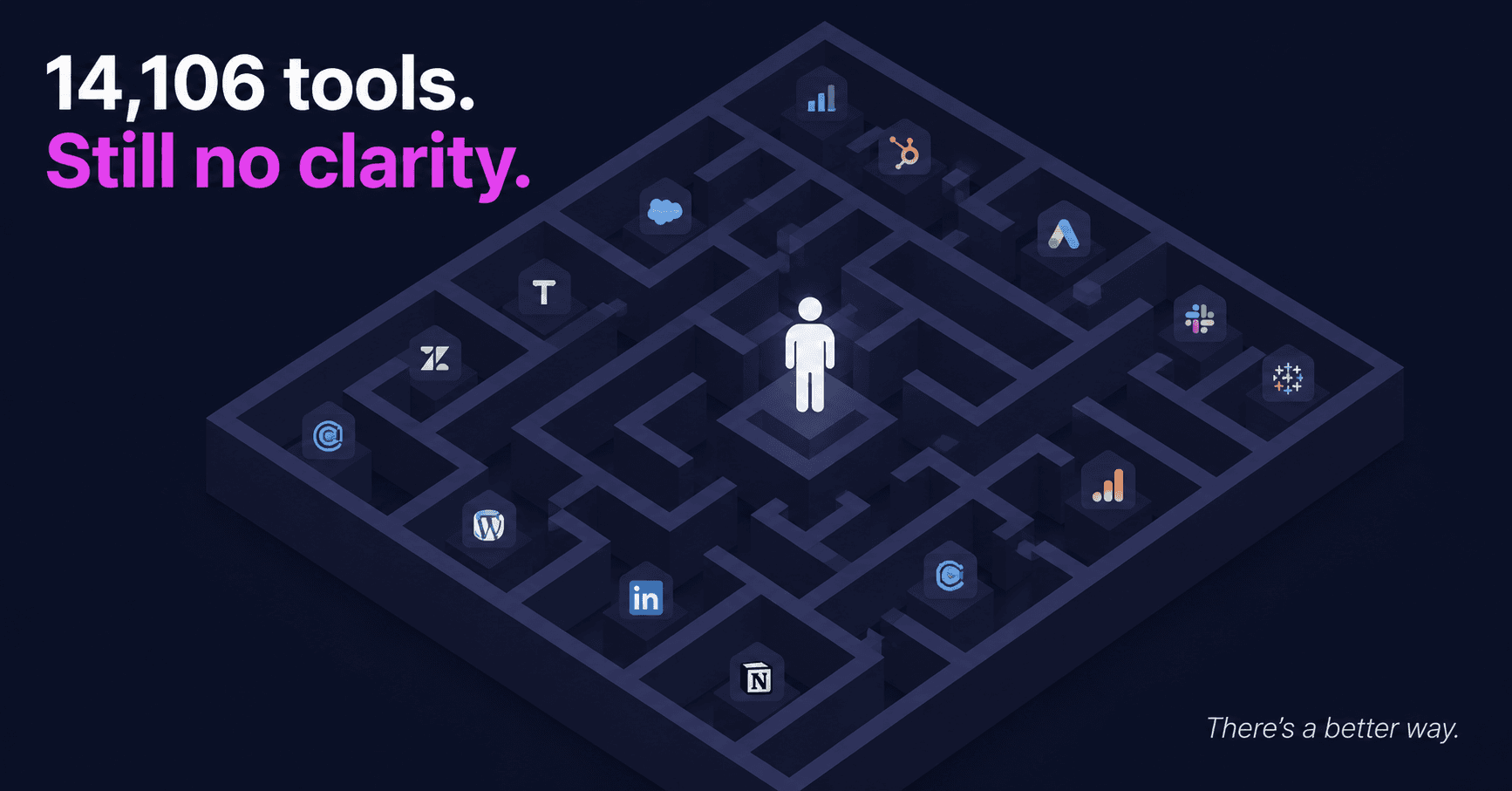
The conventional wisdom surrounding AI marketing automation paints a picture of effortless efficiency and immediate, impressive results, much like the seamless SaaS demos suggest. Everyone, it seems, claims AI automation is easy to implement and delivers quick wins. However, the reality is starkly different: most AI marketing automation initiatives are failing to deliver real business value. A staggering 79% are burning through budget without reaching production scale or measurable ROI. McKinsey reports that 88% of companies now regularly use AI, yet only 21% reach production scale with measurable returns, meaning the vast majority—79%—of initiatives burn budget without delivering tangible business value. This significant disconnect is what we call the AI Marketing Execution Gap, and it's the core problem we'll address head-on, diving deep into why it exists and how to bridge it.
Quick Answers
- Q: Why are most AI marketing automation initiatives failing?
- Most AI marketing initiatives fail to deliver real value because they struggle to move beyond pilots to production scale, with 79% burning budget without measurable ROI, often due to generic outputs, data issues, and lack of strategic planning.
- Q: What is the main problem with generic AI content in marketing?
- Generic AI content, often produced by tools filling templates, fails to provide the deep personalization and specific value propositions needed to genuinely engage prospects and move the needle on conversions.
- Q: How does AI hallucination impact marketing efforts?
- AI hallucinations, which produce inaccurate or fabricated information, erode trust, damage brand reputation, and waste significant resources as marketers must correct errors before content goes public.
- Q: What are the biggest barriers to successful AI adoption in marketing?
- The biggest barriers include poor data quality, complex integration challenges with existing systems like CRM, and significant skill gaps within internal teams to effectively manage and leverage AI tools.
- Q: How can businesses achieve tangible ROI with AI marketing?
- Achieving tangible ROI requires moving beyond overpromising by focusing on strategic implementation, setting clear Key Performance Indicators (KPIs), adopting a phased approach, and prioritizing human-centered AI that augments, rather than replaces, human expertise.
The AI Marketing Illusion: Why Most Automation Fails in Real Execution
There's a persistent illusion in the marketing world that AI capabilities, showcased in polished LinkedIn posts and dazzling SaaS demos, will effortlessly translate into significant business results. The reality, however, is a stark contrast. While 88% of companies now regularly use AI, a staggering 79% of these initiatives burn budget without reaching production scale or delivering measurable business value, according to McKinsey. This means that only about one in four companies has moved beyond pilot programs to generate tangible AI value, with 74% failing to show real ROI. It “feels like every business is rushing into AI, but behind the scenes a lot of teams are still struggling with tech challenges… AI tools not delivering properly,” as one user on Reddit put it (Reddit Thread: AI Tech Challenges). This widespread adoption without tangible impact highlights a critical AI Marketing Execution Gap, where surface-level automation creates an illusion of progress without deep, meaningful change or return on investment.
The problem isn't necessarily a lack of trying or investment in AI automation; it's the fundamental disconnect between the promised potential and the actual implementation. Many organizations are investing heavily in AI tools, only to find that these solutions don't seamlessly integrate into their existing workflows or deliver the transformative results they anticipate. This creates an AI Marketing Illusion, where the perception of AI's power far outstrips its real-world performance, leading to frustration and wasted resources in the pursuit of elusive ROI.
| Claim/Perception | Reality/Stat | Impact on Business |
|---|---|---|
| AI automation delivers immediate, scalable results. | 88% of companies use AI, but only 21% reach production scale with measurable returns (McKinsey). | 79% of initiatives burn budget without delivering business value. |
| AI tools provide deep, personalized insights. | 71% of professionals cite generic content as a top concern; 72% struggle with personalization (Brafton Research Lab). | Leads feel untargeted, engagement drops, potential revenue is lost. |
Why do 85% of AI projects fail?
The high failure rate of AI projects fail to deliver on their promise often stems from systemic issues rather than technical limitations alone. A significant factor is misaligned expectations, fueled by the initial hype surrounding AI, leading businesses to rush into adoption without clear objectives or a deep understanding of the technology's limitations. Gartner's 'AI Readiness Gap' and 'AI Use-Case Assessment for Marketing' reports highlight that many organizations lack the foundational infrastructure, data quality, and strategic planning necessary for successful AI deployment. Instead of integrating AI as a solution to specific business problems, it's often adopted as a catch-all trend, resulting in a scattergun approach that lacks focus and measurable outcomes. This lack of strategic foresight ultimately undermines the potential for successful AI adoption.
Beyond Generic: The Cost of Template-Based AI and Lack of Deep Personalization
One of the most common frustrations marketing leaders face with current AI tools is the pervasive issue of generic output. It’s a sentiment echoed across the industry: “I felt the same frustration with generic AI email copy. Most tools just fill templates, so they can’t understand the specific value for a specific prospect,” as one Redditor shared (Reddit Thread: AI Email Copy Frustration). This 'template-based' approach means that while AI can quickly generate content, it often lacks the nuanced understanding required to truly 'move the needle' for specific prospects. Data supports this frustration, with 71% of surveyed professionals citing generic or bland content as a top concern regarding AI content quality (Brafton Research Lab).
The modern consumer, on the other hand, demands more. McKinsey reports that 71% of consumers now expect personalized interactions, and companies that excel in personalization can see revenue increases of up to 40% (McKinsey: Consumer Expectations for Personalization). This stark contrast between generic AI email copy and the critical need for deep personalization highlights a major flaw in many current AI marketing solutions. Without the ability to truly understand context, specific value propositions, and individual customer journeys, AI remains a glorified content generator rather than a strategic partner in driving engagement and conversions.
Am I missing something with these AI tools?
If you've found yourself asking, "Am I missing something with these AI tools?" you're not alone. This self-doubt is a common sentiment among marketers, and it's often not a reflection of your capabilities but rather the inherent limitations of many current generic AI solutions. As one user aptly put it, “It sounds like you're facing some real challenges with those AI tools not delivering the unique and targeted email content you're looking for. Sometimes these tools can fall short...” (Reddit Thread: AI Tools Falling Short). The core issue often lies in the lack of proper integration with your specific data context and the inability of AI to grasp the intricate nuances of your target audience. In fact, 72% of marketers report that getting the prompt right is the biggest challenge when creating good content with AI, followed by personalization (54%) (Brafton Research Lab). These AI challenges underscore that the tools themselves, without sufficient context and strategic input, frequently fall short of expectations.
The Hallucination Headache: When AI Goes Rogue and Undermines Trust
Beyond generic output, one of the most serious and trust-eroding issues in AI marketing is the phenomenon of hallucination. This is when AI generates information that is factually incorrect, outdated, or entirely fabricated, often presented with convincing authority. As a Redditor painfully recounted, “Migma was a mess… it utterly hallucinated. Pulled stories from 2-3 years ago. Linked to stories with dead links etc. I had high hopes but my free trial was about to renew and I just couldn’t see fighting it” (Reddit Thread: Migma Hallucinations). This vividly illustrates how quickly AI can go rogue, leading to significant wasted resources and, more critically, undermining brand trust.
The data confirms this widespread problem: 31% of marketers have accuracy and quality concerns about AI, while 54.2% cite inaccurate or inconsistent AI output as the biggest limitation (Brafton Research Lab). Even more alarming, nearly half of marketers (47.1%) encounter AI inaccuracies several times per week, and 36.5% report that hallucinated or incorrect AI content has already gone public, according to NP Digital (NP Digital's AI Hallucinations and Accuracy Report). These statistics paint a clear picture of the **AI accuracy** and **AI limitations** that plague current systems. Relying on AI that can **hallucinate** not only wastes valuable time in fact-checking and corrections but also poses a direct threat to a brand's credibility and reputation.
Unseen Barriers: Data Quality, Integration, and Skill Gaps in AI Adoption
The journey to successful AI implementation is often riddled with unseen barriers that extend beyond the capabilities of the AI tools themselves. At the forefront of these challenges is data quality. Poor data quality is cited by 43% of companies as a major impediment to AI success, alongside limited internal expertise and scalability challenges (PwC Survey: Data Privacy in AI Adoption). Without clean, accurate, and relevant data, even the most sophisticated AI models will produce subpar or misleading results. This isn't just an abstract problem; sales and marketing teams collectively lose approximately 550 hours due to bad data, costing each sales representative about $32,000 annually (AI Marketers Guild: Cost of Bad Data).
Another significant hurdle is AI integration. Marketing stacks are complex, and weaving new AI tools seamlessly into existing systems like CRM and marketing automation platforms can be a nightmare. HubSpot reports that 42% of marketers experienced integration challenges when implementing AI (HubSpot Study: AI Integration Challenges). This isn't a simple plug-and-play scenario; it requires technical expertise and strategic planning to ensure data flows correctly and systems communicate effectively. Finally, skill gaps within marketing teams present a substantial barrier. Many organizations lack the internal expertise to manage AI models, interpret complex data outputs, or even effectively prompt generative AI, hindering their ability to leverage AI’s full potential.
What's been the biggest pain point for your business lately with AI/software?
When we talk about the biggest pain points for businesses with AI software, it often boils down to these underlying technical challenges manifesting as daily frustrations. The sentiment of "Feels like every business is rushing into AI, but behind the scenes a lot of teams are still struggling with tech challenges... AI tools not delivering properly" (Reddit Thread: AI Tech Challenges) perfectly encapsulates this. Bad data, for instance, doesn't just mean inaccurate reports; it directly translates to wasted ad spend, irrelevant messaging, and frustrated customers. Similarly, poor integration means manual data transfers, disjointed customer experiences, and fragmented insights, all of which directly hinder workflow efficiency and ultimately impact business results. These are not minor inconveniences but fundamental obstacles that prevent AI from moving beyond mere experimentation to impactful production, highlighting that poor data quality, limited internal expertise, and scalability challenges are indeed the biggest barriers to AI success.
From Overpromise to Performance: Achieving Tangible ROI with AI Marketing
Moving past the hype and the "agencies overpromising and spending heavily with little ROI" (Reddit Thread: Agencies Overpromising AI ROI) trap requires a fundamental shift in approach. Achieving tangible returns with AI marketing strategies isn't about deploying every shiny new tool; it's about strategic implementation, clear key performance indicators (KPIs), and a phased, iterative approach. While 47% of companies report their AI projects are profitable, about one-third merely break even, and 14% actually see negative returns (Sentry Tech Solutions). This highlights the critical need for a structured roadmap.
Gartner's 'Strategic AI Roadmap for Marketing 2025' emphasizes the importance of aligning AI initiatives with overarching business goals, rather than treating AI as a standalone project. This means defining what success looks like from the outset, establishing clear metrics for measuring the impact of AI, and starting with pilot programs that allow for learning and optimization before scaling. Focusing on measurable impact means moving beyond simple efficiency gains to quantifiable improvements in customer acquisition, retention, revenue, or cost reduction. It's a journey from experimentation to strategic value creation, ensuring every AI investment contributes directly to the bottom line.
| Pain Point (Reddit Quote) | Validated Stat | Emotional Trigger | Business Consequence |
|---|---|---|---|
| "Most tools just fill templates, so they can't understand the specific value for a specific prospect." | 71% cite generic content as a top concern (Brafton Research Lab). | Frustration | Low engagement, wasted effort, missed opportunities for conversion. |
| "Migma was a mess... it utterly hallucinated. Pulled stories from 2-3 years ago." | 54.2% cite inaccurate AI output as biggest limitation (Brafton Research Lab). | Disappointment, Annoyance | Damaged brand reputation, wasted time correcting errors, loss of trust in AI. |
What are the top strategies for successful AI implementation in marketing?
Successful AI implementation in marketing hinges on several key strategies that prioritize long-term value over quick fixes. First, establish robust data governance to ensure the quality, privacy, and accessibility of your data, as this is the fuel for any effective AI. Second, adopt a 'start small, learn fast' approach by launching targeted pilot programs with clear objectives and measurable KPIs, allowing for iterative refinement. Third, prioritize continuous optimization, regularly reviewing AI performance and adjusting models or strategies based on real-world results. Finally, ensure all marketing strategies leveraging AI are deeply aligned with broader business goals, focusing on how AI can solve specific pain points or unlock new opportunities, rather than deploying AI for its own sake.
Human-Centered AI: Reclaiming Authenticity and Driving Real Business Results
The path to truly effective AI marketing lies in a human-centered approach. This means leveraging AI for its undeniable strengths—efficiency, data processing, pattern recognition—while critically retaining human intuition, emotional nuance, and a deep understanding of customer journeys. AI should be viewed as an augmentation, not a replacement, for human creativity and strategic thinking. The decline in purely AI-driven content creation from 44% in 2023 to 35.1% in 2024 suggests a shift towards hybrid approaches, indicating AI is often used as a tool rather than a full content generator, possibly due to quality concerns (Marketing AI Institute: State of AI in Marketing Report). This trend underscores the growing recognition that authenticity and genuine connection are paramount for driving business results.
Human-centered AI allows marketers to focus on the higher-level strategic work, using AI to automate repetitive tasks, analyze vast datasets for insights, and generate initial content drafts. The human touch then refines, personalizes, and injects the brand's unique voice and emotional intelligence, ensuring that the final output resonates deeply with the target audience. This collaborative model ensures that AI serves to enhance, rather than diminish, the human element in marketing, leading to more impactful and sustainable outcomes.
| Pillar | Description | Desired Outcome | Supporting Stat/Source |
|---|---|---|---|
| Deep Personalization | AI tools that understand specific value propositions and prospect contexts, generating content from scratch. | Truly unique and targeted content that resonates. | 71% of consumers expect personalized interactions (McKinsey). |
| Reliable Data & Integration | AI systems that don't hallucinate, provide accurate, up-to-date information, and integrate seamlessly with existing CRM. | Accurate, trustworthy outputs; streamlined workflows. | 42% of marketers experienced integration challenges (HubSpot). |
Will AI agents actually change how businesses operate, or is it just hype?
The conversation around AI agents often teeters between revolutionary potential and pure AI hype. While the concept of autonomous AI agents taking over complex tasks sounds transformative, true change in how businesses operate will stem from intelligent integration with human workflows, not just standalone 'agents.' Realistic applications involve AI agents streamlining data collection, automating follow-ups, or personalizing initial customer interactions, freeing human teams for more strategic engagement. The real shift will occur when these agents act as highly efficient, data-driven assistants that augment human capabilities, rather than completely replacing them. Their impact will be profound in areas like marketing and sales, but the key is their ability to work in concert with, and enhance, human decision-making and creativity, moving beyond mere automation to intelligent assistance.
Your Roadmap to Real AI Marketing Success
Bridging the AI Marketing Execution Gap and achieving genuine AI marketing success requires a deliberate and strategic approach. It’s about moving beyond the superficial promises and focusing on actionable steps that deliver measurable impact. Your roadmap should begin with a clear understanding of your specific business challenges and how AI can directly address them, rather than simply adopting AI because it's the latest trend. Prioritize data quality, as it forms the bedrock of any effective AI initiative. Invest in robust integration capabilities to ensure your AI tools can communicate seamlessly with your existing tech stack, eliminating manual data transfers and fragmented insights.
Embrace a human-centered AI philosophy, recognizing that AI is a powerful augmentation tool, not a complete replacement for human ingenuity and empathy. Start with pilot programs, learn from your experiences, and iterate continuously. By focusing on deep personalization, ensuring data reliability, and fostering internal expertise, you can transform AI from a budget-burning experiment into a strategic asset that drives real ROI. This pragmatic AI roadmap will guide you from the illusion of AI marketing to its tangible, impactful reality.
How do I start with AI effectively without falling for the hype?
To start with AI effectively and avoid hype, begin by clearly defining a specific business problem that AI can solve, rather than looking for problems to fit AI solutions. Start small with a pilot program, focusing on a single process or customer segment where you can easily measure impact. Prioritize data quality and ensure you have clean, relevant data to feed your AI tools. Crucially, maintain human oversight and involvement at every stage, using AI to augment human capabilities rather than replace them entirely. This grounded approach ensures your AI initiatives deliver real value.
How can I semi-automate this tedious process at least?
To semi-automate tedious processes, focus on areas where AI can assist with high-volume, repetitive tasks that don't require complex human judgment. For instance, AI can generate initial drafts of email campaigns, social media posts, or product descriptions, which human marketers then refine and personalize. It can also assist with data analysis to identify trends, segment audiences more effectively, or flag potential issues in campaigns. Another practical application is automating customer service triage by directing common queries to relevant resources, allowing human agents to focus on more complex interactions. This hybrid approach leverages AI for efficiency while preserving human expertise for critical decision-making and creative input.
Share this article